Blog
Wedding reception timeline: a template you can copy
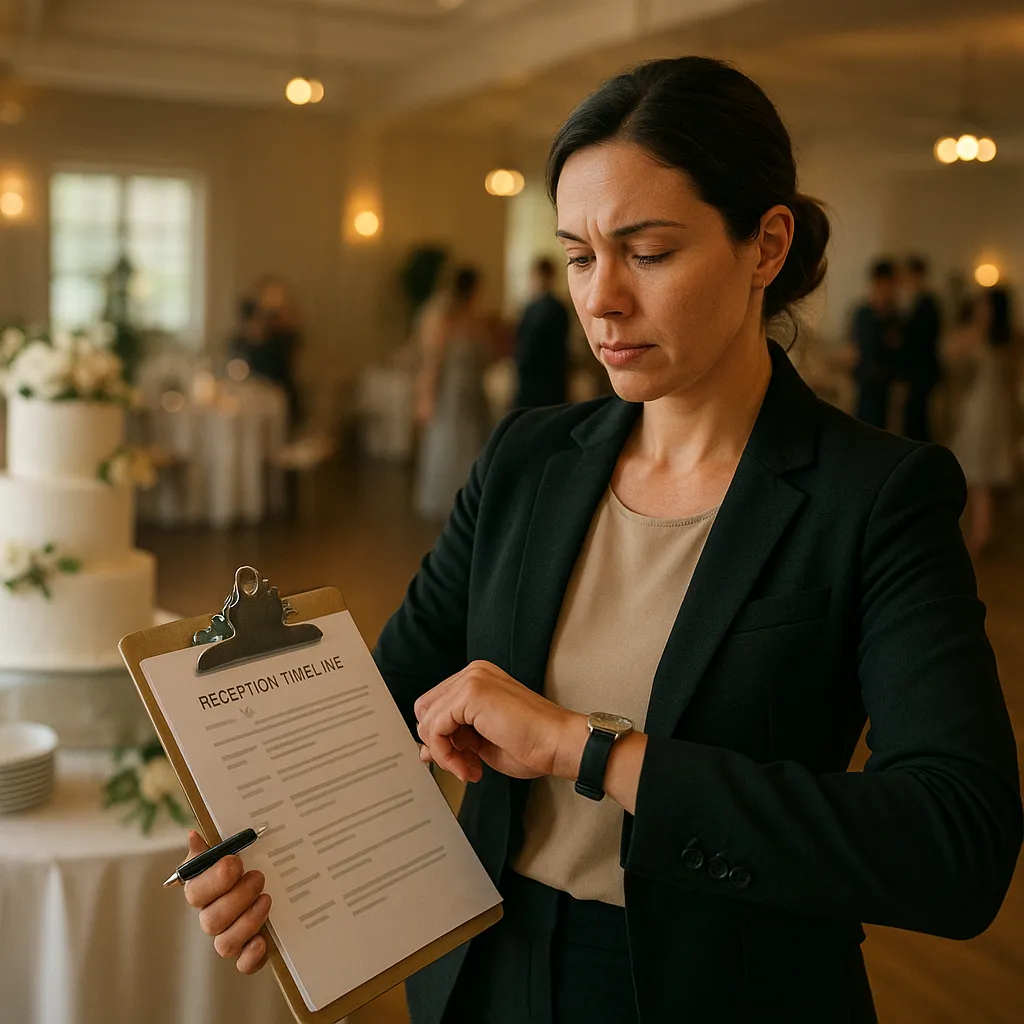
- Give every reception moment a start time, a duration, an owner, an announcement cue, and a music cue. That is a usable wedding timeline template.
- The copyable five-hour schedule below starts with cocktail hour and ends with the exit. Shift the first time to match your own day.
- Put the planner or venue coordinator in charge of time, the caterer in charge of food readiness, and the DJ, bandleader, or MC in charge of announcements and music.
- Keep the formal moments short. The extra time belongs to dinner, dancing, photos, and the little delays that happen at every wedding.
A wedding reception timeline has a grand entrance, dinner, toasts, a first dance, parent dances, cake, a bouquet toss, open dancing, a last dance, and an exit. The hard part is not making a list. It is giving each one enough time, telling the right person when it is coming, and not discovering at 9:50 p.m. that you still have half the list left.
A useful wedding reception timeline is a shared cue sheet. The planner or venue coordinator keeps time. The caterer says when food is ready. The DJ, bandleader, or MC makes the announcement and starts the music. The photographer gets warning before any moment you want photographed. Copy the template, replace the times, and give it to those four people.
Copy this five-hour wedding reception timeline
This schedule for a wedding reception runs from 6:00 to 11:00 p.m. and includes a one-hour cocktail hour. The Knot describes five hours, including cocktails, dinner, and dancing, as a typical reception length. Treat this as a starting shape, not a rulebook. A buffet, a large wedding party, cultural traditions, or a venue cutoff can move the order.
| Time | Moment | Who cues it | Music and announcement |
|---|---|---|---|
| 6:00–7:00 | Cocktail hour | Planner or venue coordinator opens the reception space; caterer confirms dinner timing. | Background music. No announcements unless guests need a location or timing update. |
| 6:45 | Wedding party lines up | Planner gathers the people entering. DJ, bandleader, or MC confirms name pronunciation and order. | Keep cocktail music going for guests. Entrance music is standing by. |
| 7:00–7:10 | Guests take seats | Venue coordinator opens the room; planner checks that the couple and wedding party are ready. | Upbeat seating music, then a brief announcement asking guests to find their seats. |
| 7:10–7:20 | Grand entrance and first dance | MC introduces each entrance. Photographer gets a five-minute warning. | One entrance song or a short cue for each group, then the couple’s first-dance song. |
| 7:20–8:05 | Dinner begins | Caterer starts service. Planner checks when the first course reaches the couple. | Low dinner music. No long speeches while guests are still finding seats. |
| 8:05–8:20 | Toasts | Planner has speakers ready. MC introduces each speaker and gives the photographer a cue. | Music fades out. Keep each toast to the agreed order and time. |
| 8:20–8:30 | Parent dances | MC brings the couple and parents to the floor. Photographer is in place before the announcement. | Play the selected parent-dance songs back to back. Invite guests onto the floor after the final song. |
| 8:30–9:30 | Open dancing, first block | DJ, bandleader, or MC runs the floor. Caterer serves dessert without a room-wide interruption if possible. | Dance music. Announce only something that truly needs every guest’s attention. |
| 9:30–9:40 | Cake cutting | Planner confirms the cake is in place; photographer and caterer are ready; MC brings guests’ attention over. | One short announcement and a cake-cutting song or brief music bed. |
| 9:40–9:50 | Bouquet toss or another optional tradition | Planner checks that the couple wants to do it. MC gives a simple instruction. | One designated song. Skip this row entirely if it is not part of your night. |
| 9:50–10:50 | Open dancing, second block | DJ, bandleader, or MC runs the floor. Planner quietly checks exit logistics with the photographer and venue. | Dance music. Keep the exit song ready but do not announce it yet. |
| 10:50–10:55 | Last dance | MC makes the final call; planner makes sure the exit items and photographer are ready. | Announce the last dance, then play the one song you selected for it. |
| 10:55–11:00 | Exit | Planner or venue coordinator directs guests. Photographer leads the couple into position. | Exit song if you want one. The music ends at the venue’s required cutoff. |
The music details deserve their own plan. Use our wedding music timeline, hour by hour for ceremony music, cocktail-hour music, dinner volume, dance sets, and the venue cutoff. This page is the reception schedule that tells everyone when those things happen.
Who owns each part of the schedule for a wedding reception?
Do not make the couple the air-traffic controller. Assign the jobs before the wedding and put the names beside them on the final timeline.
Planner or venue coordinator
Owns the clock, gathers people before their cue, and resolves a delay before it becomes a room-wide announcement.
DJ, bandleader, or MC
Owns the microphone: introductions, announcements, song starts, song fades, and the next cue.
Caterer
Owns food readiness. The schedule needs a real answer to “are we ready to serve?” before anyone invites guests to sit down.
Photographer
Owns the shot, not the clock. Give a five-minute warning before entrances, dances, toasts, cake, and the exit.
How to make this a four-hour reception timeline
A four-hour reception has no spare hour to absorb a late dinner or five separate speeches. Keep cocktail hour to 45 minutes, make the grand entrance and first dance a single fifteen-minute block, and choose no more than two toast speakers. Put cake and bouquet together in one ten-minute formal-moment break. That leaves about 90 minutes for dancing.
| Time | Four-hour schedule | Music or announcement |
|---|---|---|
| 6:00–6:45 | Cocktail hour | Background music. |
| 6:45–7:00 | Guests seated, grand entrance, first dance | Seating announcement, entrance cue, then first-dance song. |
| 7:00–8:00 | Dinner and up to two toasts | Low dinner music; microphone only for the toast block. |
| 8:00–8:10 | Parent dances | Two selected songs, with no gap between them. |
| 8:10–9:05 | Open dancing, first block | Dance music. |
| 9:05–9:15 | Cake and bouquet toss, if included | One short announcement and designated cue songs. |
| 9:15–9:50 | Open dancing, second block | Dance music. |
| 9:50–10:00 | Last dance and exit | Final-call announcement, last-dance song, exit music. |
How to make this a six-hour reception timeline
A six-hour reception does not need more formalities. Keep the same order, give dinner time to breathe, and add the hour to open dancing. A longer cocktail hour makes sense when photos or a room flip need it. A longer dance block makes sense when the reception is already in one space and the floor is the point of the night.
Here is a six-hour version starting at 6:00 p.m. This version puts the added time into the two dance blocks. Do not fill it with another speech block. That is how a flexible schedule becomes a long one.
| Time | Six-hour schedule | Music or announcement |
|---|---|---|
| 6:00–7:00 | Cocktail hour | Background music. |
| 7:00–7:20 | Guests seated, grand entrance, first dance | Seating announcement, entrance cue, then first-dance song. |
| 7:20–8:10 | Dinner begins | Low dinner music. |
| 8:10–8:25 | Toasts | Music fades out for the speakers. |
| 8:25–8:35 | Parent dances | Selected parent-dance songs. |
| 8:35–9:50 | Open dancing, first block | Dance music. |
| 9:50–10:05 | Cake and bouquet toss, if included | Short announcements and designated cue songs. |
| 10:05–11:50 | Open dancing, second block | Dance music. |
| 11:50–12:00 | Last dance and exit | Final-call announcement, last-dance song, exit music. |
Where music and announcements fit in the wedding timeline template
Mark each row with one of four instructions: background music, cue song, microphone moment, or dance set. That small label tells the entertainment team what to prepare and tells the planner when to get people in place.
- Background music: cocktail hour, guest seating, dinner, and dessert service.
- Cue song: grand entrance, first dance, parent dances, cake cutting, bouquet toss, last dance, and exit.
- Microphone moment: seating request, introductions, toasts, dinner release, formal-moment instructions, and last-call announcement.
- Dance set: the uninterrupted blocks after parent dances and after cake or bouquet.
At a wedding, Ricky Bobby, the three-piece cover and party band can cover ceremony music from your song list, an acoustic cocktail-hour set, a softer dinner set, announcements, and dance sets in any combination. Its PA and microphones are available for announcements, toasts, and speakers. Learn how that fits your day on our wedding music page, or see the live band and DJ options.
What to send your vendors one week before the wedding
Send one clean version, not separate texts that conflict. Put these items at the top:
- Venue address, access instructions, and the exact music cutoff.
- Start and end time for every reception block.
- Names and pronunciation for everyone being introduced.
- Song title and artist for every cue song, plus a backup if the song is unavailable.
- Toast order, with each speaker’s name and a requested time limit.
- Who has authority to shorten or skip a moment if the timeline slips.
- Phone numbers for the planner or coordinator, catering lead, photographer, and entertainment lead.
WeddingWire recommends sharing a clear timeline with vendors and naming a day-of keeper of the timeline. That is sound advice. A schedule only works if the people holding it know which decisions they can make without stopping the couple for an answer.
Common questions
What is the order of events at a wedding reception?
A useful standard order is cocktail hour, seating, grand entrance, first dance, dinner, toasts, parent dances, open dancing, cake, bouquet toss if you want it, more open dancing, last dance, and exit. The order can change. What matters is assigning each moment a time, owner, music cue, and announcement.
How long should a wedding reception be?
The Knot says a typical reception is about five hours, including one hour for cocktails and four hours for dinner and dancing. Four hours can work with fewer formal moments. Six hours gives you room for a longer cocktail hour or more dancing.
Who announces the wedding reception timeline?
The planner or venue coordinator usually keeps the timeline moving. The DJ, bandleader, or MC usually makes introductions and announcements, then starts the music cue. Put one person in each role before the day.
When should cake cutting and the bouquet toss happen?
Place them after the first open-dancing block, then return to dancing. If you are skipping either tradition, delete that row and give the time back to the dance floor.
Sources
- The Knot, “The Wedding Reception Timeline You Need to Plan Ahead”. The publisher describes a typical reception as about five hours, including one hour for cocktails and four hours for dinner and dancing, and publishes a sample order of reception events. Read October 7, 2026. theknot.com
- WeddingWire, “A Wedding Day Timeline Template & Rules to Follow”. The publisher advises couples to distribute a clear timeline to vendors and appoint a day-of keeper of the timeline. Read October 7, 2026. weddingwire.com
- WeddingWire, “Your Wedding Reception Order of Events: A Simple Step-by-Step Timeline”. The publisher’s example includes entrances, first dance, cake cutting, bouquet toss, last dance, and grand exit, while noting that some are optional. Read October 7, 2026. weddingwire.com