Blog
How do you have live music at a backyard party in Austin?
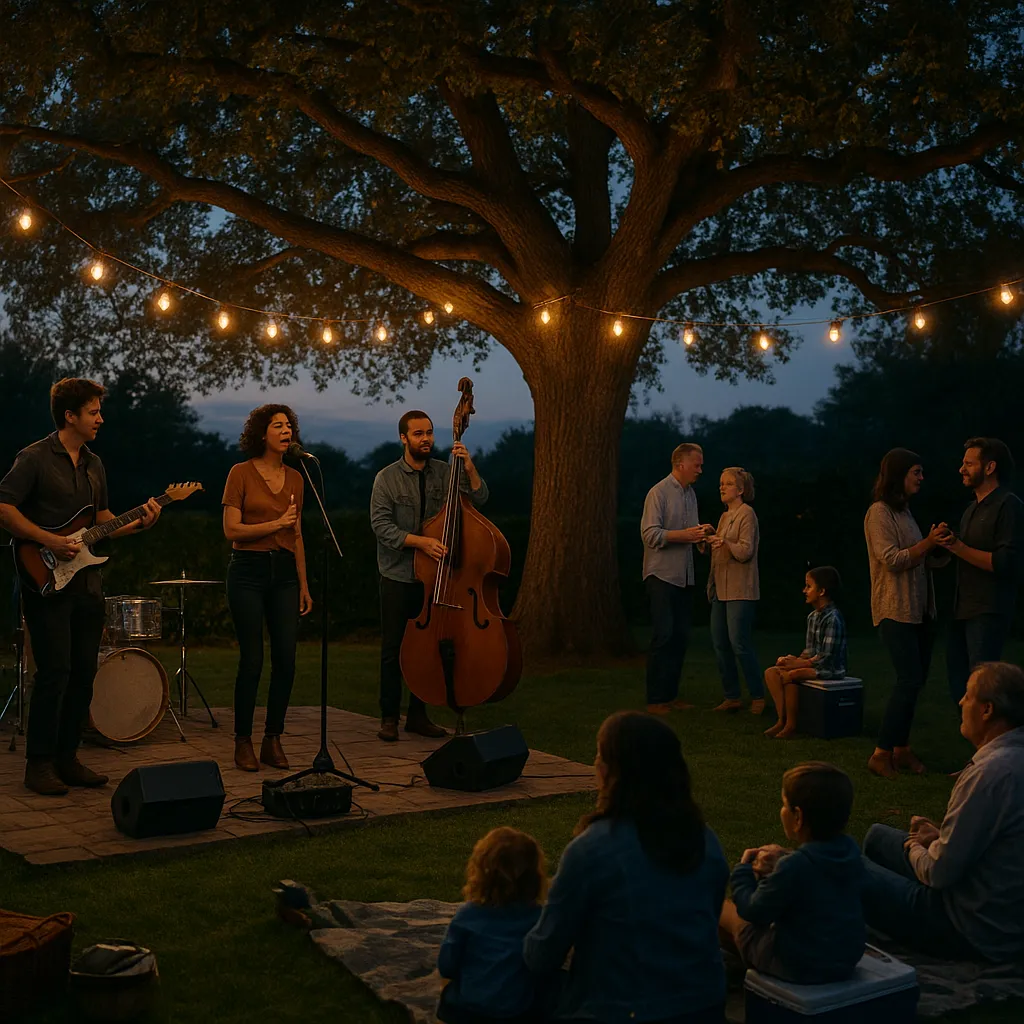
- Up to 75 decibels, from ten in the morning until ten at night. That’s the window for amplified sound at an Austin home.
- You can’t buy a permit to play louder or later. A residential address isn’t eligible for one.
- Electricity is the other constraint: a band playing all evening counts as a continuous electrical load under the electrical code.
- Aim the PA away from the property line, and schedule the loud part of the night early. The neighbors are the enforcement mechanism.
Most advice about backyard music isn’t tied to a place, so it stops being useful when a neighbor calls. Austin posts specific numbers that are stricter and more detailed than many people expect.
From the City of Austin’s own page on outdoor amplified sound: Austin City Code allows amplified sound on residential property from 10 a.m. to 10 p.m. at a maximum of 75 decibels. Amplified sound may not be audible beyond the property line from 10 p.m. to 10 a.m.
Here is the part that changes plans. The same city page states that residential property does not require, and is not eligible for, an outdoor sound permit. Austin has a whole permitting system for outdoor amplified sound, and a house cannot use it.
In Austin, amplified sound on residential property is allowed from 10 a.m. to 10 p.m. at up to 75 decibels, and a residential address is not eligible for an outdoor sound permit, so that window is fixed rather than negotiable.
Which rules govern live music at an Austin house?
Noise and amplified sound are covered in Title 9, Chapter 9-2 of the Austin Code of Ordinances. Read the city’s page before your event instead of relying on this one, because the city is the authority.
Three key limits
Sound
Most people picture seventy five decibels as louder than it really is. The number matters less than how the rule gets applied: the limit and the audibility check both reference the property line. What counts, then, is not how hard the band plays but the direction the speakers point and what stands between them and the neighbors.
Point the PA toward the yard rather than across it. Put the loudest part early instead of at nine forty-five. Let the neighbors know ahead of time, and decide who will answer the door if someone knocks. That final choice may seem minor, but it determines whether the knock leads to a conversation or a complaint.
Power
A home is not a performance space. Everything else in the building shares the same residential circuits, and the electrical code considers a band running all evening a continuous load. Schneider Electric, explaining the code, notes that a continuous load is one where the maximum current is expected to continue for 3 hours or more, and that a branch circuit breaker must handle noncontinuous load plus 125 percent of the continuous load.
For practical purposes, you can use roughly 1,920 watts from a standard 20-amp circuit, not the 2,400 suggested by basic math. What matters isn’t the number of outdoor outlets; it’s how many distinct circuits supply them and what else draws power from them. Warmers used by a caterer on that line are more likely to trip the breaker than the band.
Access
Think about where a van can stop, how far the gear has to be carried to the setup area, and what sits along that path. Gravel, a gate, a step, stairs, or a lawn each slow things down. If the load-in means a long carry over grass, tell the band when you book rather than letting them find out when they arrive.
- 75
- Maximum decibel limit for amplified sound at an Austin home
- 10 to 10
- Hours when amplified sound is allowed
- 1,920
- Usable wattage on a 20-amp circuit for an evening-long load
- 50
- Guest count above which a non-residential event needs a special event permit
A backyard party
You make the decisions at your own place, with no coordinator to pay and no venue fee to cover. In return, you handle the issues a venue usually takes care of: parking, electricity, restrooms, weather, and a fixed ten o’clock curfew that cannot be changed.
Renting a venue
Your money pays for the setup: an electrical panel with enough capacity for a band, a planned load-in route, parking, and staff. You may also get a later curfew if the property has the right permit.
One note on jurisdiction
The details above apply to the City of Austin. Round Rock, Georgetown, Cedar Park, Dripping Springs and unincorporated Travis or Hays County follow their own rules; Austin’s ordinance does not apply to a Hill Country address twenty minutes beyond the city. Check the jurisdiction your address actually sits in.
When a gathering grows past backyard size, Austin Fire’s special events permits cover tents, generators, and public assembly, and generators have to be placed twenty feet away from any tent.
What a band needs from a house
- A firm, level setup area with shade from direct sun if it is July.
- Access to two or more separate circuits and a heads-up about what else is plugged into them.
- Space to park a van close enough for a reasonable carry.
- A rain plan that doesn’t force a seven o’clock scramble.
- An end time everyone has agreed on before the day arrives.
A backyard party gets the same treatment from us as a ballroom show: our own PA and lights come along, and the rig just shrinks instead of changing. If the rest of the evening is still coming together, what to ask a band before you book them goes over the contract side.
See what a backyard booking with us looks like on the private events page, including the acoustic setup for smaller gardens.
Common questions
When does the music have to stop at a house party in Austin?
10 p.m. On residential property, the city allows amplified sound from 10 a.m. to 10 p.m. at a maximum of 75 decibels. After 10 p.m., the city says amplified sound may not be audible beyond the property line. Other cities and the unincorporated county set their own rules.
Does a backyard band in Austin need a permit?
No, and you can’t get one. The city states that residential property “does not require, and is not eligible for” an outdoor sound permit. Because of that, you cannot apply to push the cutoff later or go louder than the current 10 a.m. to 10 p.m. limit at 75 decibels.
Can a full band play a backyard party?
Yes, as long as the power and access are sufficient. The main limitations involve how many circuits supply the area, what other devices are using them, and the distance the gear has to be carried from where a van can park. Neither usually becomes a problem once someone assesses the situation.
Sources
- City of Austin, Arts, Culture, Music and Entertainment, “Outdoor Amplified Sound”. “Austin City Code allows amplified sound on residential property from 10 a.m. to 10 p.m. at a maximum of 75 decibels. Amplified sound may not be audible beyond the property line from 10 p.m. to 10 a.m.” Residential property “does not require, and is not eligible for” a sound permit. Read July 27, 2026. austintexas.gov
- Austin Fire Department, “Special Events”. Published permits for tents, outdoor events, public assembly and open flame, the requirement that all events are subject to site plan approval and fire inspection, and the twenty-foot generator separation from tents. Read July 27, 2026. austintexas.gov
- Schneider Electric, “Clearing up confusion over 80% vs. 100%-rated circuit breakers”. Explaining NFPA 70 section 210.20(A): a breaker must handle noncontinuous load plus 125% of the continuous load, and “A continuous load is one where the maximum current is expected to continue for 3 hours or more.” Read 27 July 2026. blog.se.com
- The Knot, “36 Questions to Ask a Wedding Band That You Don’t Want to Forget”. Covers asking a band about its contingency plan for bad weather during outdoor events, and the amount of space required for the performers and their equipment. Read July 27, 2026. theknot.com
- The Knot, “This Is the Average Wedding Cost, Backed By Data”. The 2026 Real Weddings Study provides national context for live music costs. Read July 27, 2026. theknot.com