Blog
Do you need a harpist, a pianist, or can a band play your ceremony?
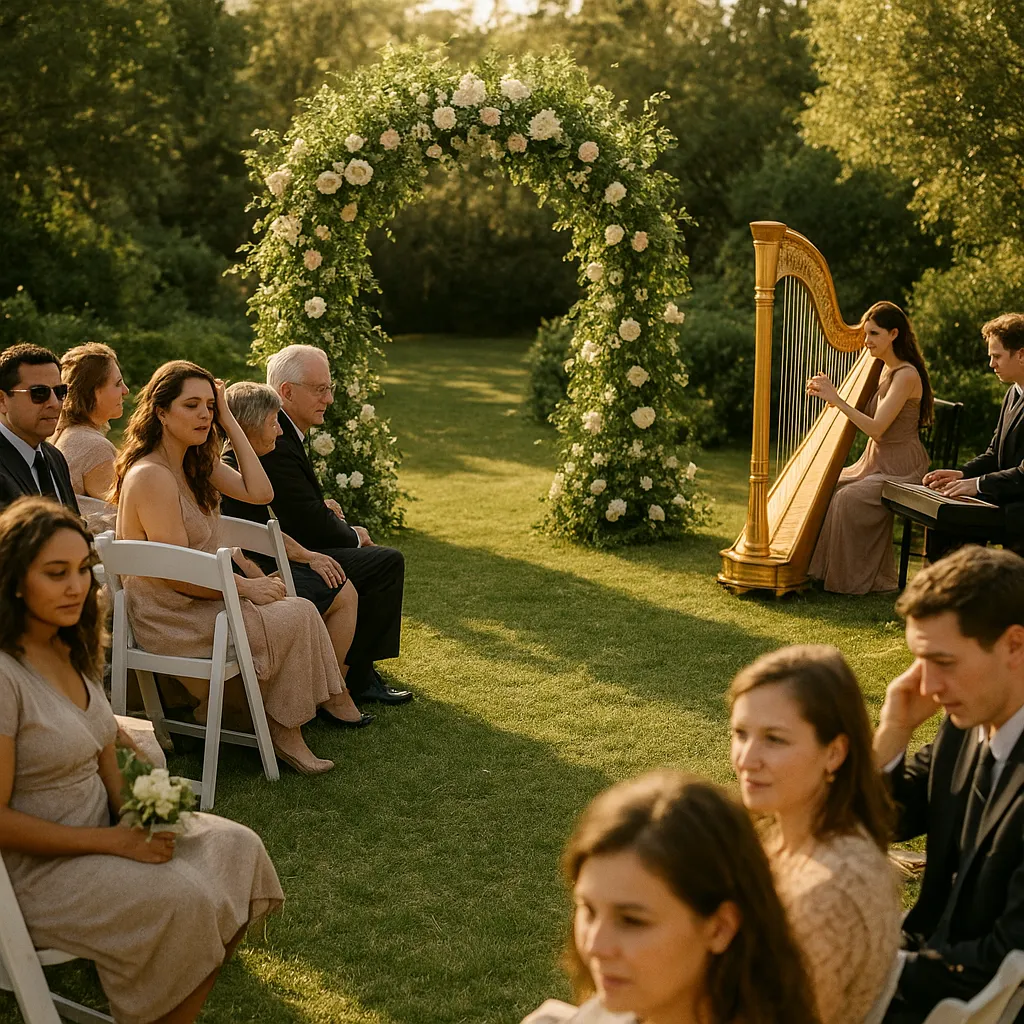
- Much of this is already decided for you. Churches often supply the organist and require anyone else to be approved first.
- Acoustic musicians publish limits for their instruments in their contracts. Several set a maximum of 85F, but Austin’s normal daily high is above that mark from May through September.
- A band can play the ceremony. There are also ceremonies where a solo harp is the better answer, and we will tell you which one you have.
- Before choosing a playlist, answer two questions: what has the venue already decided, and where, exactly, will the musicians sit?
Most people come to this question through the sound they have in mind. A string section under the vows, or an organ filling a stone room. From there they hunt for the musician who can make that sound.
That sequence works roughly half the time. In the other half, the venue or forecast has already made that sound impossible, but nobody brings it up until late.
The room and the weather usually decide which instrument fits your wedding ceremony more than personal preference does.
Start with what's already decided
If you are marrying in a church, read its music policy before you shortlist anybody. Three Austin parishes publish theirs, and all three answer this question for you to some degree.
According to Saint Mary Cathedral, secular music and selections in a contemporary, casual style are not possible. The wedding fee includes an organist and cantor, paid directly by the Cathedral, and it suggests using only its own professional staff. Outside musicians have to be pre-approved two months before the date.
St. Ignatius Martyr states its rule plainly: the Director of Music is always required to provide the music for weddings. An outside organist, pianist or cantor can be allowed only in exceptional cases. The parish publishes rates of $300 for an organist or pianist and $200 for a cantor. At St. Theresa, its parish musicians and organist will provide the music; the Director of Music must approve any additional instrumentalists.
These restrictions are neither unreasonable nor unusual. An organ also cannot travel with you the way the other instruments on this page can. Because an organ is part of the building, whether one is available depends on the venue rather than your choice.
Outdoor and event sites settle a smaller piece of the same question. One Hill Country venue says on its site that soloists and non-amplified musicians are allowed for the ceremony, and in another place that every reception band needs approval beforehand.
Space requirements for each option
| Who plays | What it needs | Where it struggles |
|---|---|---|
| Pedal harp | A level, shaded, solid spot roughly 4ft by 6ft, reachable without stairs, ready an hour before you need it | Heat, moisture, wind and uneven ground, each addressed in contract terms rather than left to preference |
| A trio or quartet of strings | Chairs, shade, calm air and space for stands | Direct sun and any wind strong enough to move sheet music |
| Pianist | An instrument. The venue can provide one, or the player can bring a digital piano, which needs power and a level place | Venues that figure you already knew there was no piano |
| Organ | A building with one already in place | It can't be moved. The venue's own organist and its own rules usually come with it |
| Acoustic small band | Power, a few feet of flat ground, and the venue’s permission if anything is amplified | Sites permitting only unamplified musicians |
People are caught off guard by the first two rows, since those limits are set out in writing. Harpist Elizabeth Landis makes the weather clause of her contract public, and it gets specific: heat over 85F can expand the wood and melt the epoxies, letting seams and joints shift, while 60F cold contracts the wood so finishes crack, and under no condition should a harp face precipitation or excessive humidity. That same clause calls for winds below 18mph, a shaded area of at least four foot by six foot kept clear of mud and mulch, access an hour in advance, and a person to help carry the instrument when there are stairs and no ramp.
These are not picky demands. More than 2,000 parts move inside a concert grand pedal harp, and glue holds much of its wood together. Harpist Hannah Warren calls harps temperamental instruments that cannot stand extreme temperatures, high or low humidity, or precipitation. She offers a guideline, not a rule: most harpists prefer about 15C to 30C, or 59F to 86F.
Players in string groups set limits much like those. An outdoor wedding contract from violist Emily Rideout, quoted in Strings Magazine, specifies an acceptable temperature range of 55 to 85 degrees and requires shelter from wind, direct sun and rain. She finds that range to be generous. One quartet reports that it has on rare occasions declined to perform outside when no suitable shade was available, because sunlight damages some antique instruments.
How Austin summer weather measures against those limits
Two of those published maximums land at 85F. The local weather, measured at the National Weather Service station at Camp Mabry, is stacked against them below.
- 96.6
- Austin's normal daily high for July in degrees F. For August, it is 97.8
- 5
- Months with a normal high above 85F: May through September
- 122.8
- Annual days at 90F or above, based on the 30 year normals
- 4 x 6
- Feet of level shaded ground a pedal harp contract can require
The normal daily high is an average of the afternoon peaks, and outdoor ceremonies run during those hours. That leaves an unshaded ceremony past the limits in ordinary acoustic musicians’ contracts for much of Austin’s wedding calendar.
The next step is practical and fairly small. Treat shade as essential gear rather than decor. A covered spot, tent, or porch can mean the difference between having the music you booked and having a conversation about it an hour before the ceremony. Put the shade location in writing when you book.
When a harp or quartet makes more sense
On occasion the answer is clearly yes, and we’d rather admit that up front than once you’ve handed us the money.
- Good acoustics in a small indoor room. In a chapel, a solo harp or string trio creates a sound that guitar, bass and drums cannot copy, while amplification needs careful handling in that room.
- A traditional classical program. When the standard classical ceremony repertoire performed in its own style is what you’re after, bring in the specialists who perform it every weekend.
- A church whose music policy resembles the three above. Your fee may already cover the organist, while hiring other musicians costs more for less.
- A ceremony you want visually understated. A single instrument with a single player occupies less room than any band, including ours.
What a three-piece can actually do during a ceremony
We handle ceremonies on request rather than as a fixed package. You pick the songs and tell us exactly where they go in the order. We learn them even if they are not on our regular setlist. We can play acoustically, swapping the full drum kit for percussion, the same way we set up for a cocktail set. We supply our own PA and lights, or we can plug into the house system. If the venue allows amplification, the ceremony, cocktail hour and reception turn into one booking, one soundcheck and one point of contact.
A venue that permits only non-amplified musicians during the ceremony sets a firm rule for us and everyone else. Ask the venue first and tell us what it says. We’ll be direct about whether your plans can work there.
One practical benefit belongs to live players of any kind, not only bands. A processional’s timing can never be pinned down in advance, because someone always pauses. Live musicians keep an eye on the aisle and play on until you arrive. That’s the reason a solo harpist outperforms a recording at that moment.
One act or two?
Often the question about instruments turns into another one entirely: is a separate act for the ceremony something you need?
Ceremony musicians separately
The exact instrument you pictured is what you receive. Along with it comes another contract, another load-in, another set of weather requirements to meet, and a transition between the end of the ceremony and whatever plays after it.
One act for the whole day
A single contract and a single arrival, with no gap in the music while anyone changes over. In exchange, the ceremony’s sound is limited to whatever that act can manage acoustically, and that’s a genuine trade-off rather than a small detail.
There is no single right choice. A cathedral with a staff organist makes that choice for you. For an outdoor Hill Country site in October, using one act all day is usually easier and costs less. At that same site in August, shade settles the question first.
The questions to ask, in order
- Does the venue have a written music policy that names approved musicians, an in-house organist, or a limit on amplification?
- Is the ceremony indoors, under cover, or out in the open, and precisely where does the shade fall at the hour it begins?
- Is an outlet within reach of the players’ setup spot?
- How does the route to the spot look for the musicians: flat ground, stairs, gravel, or grass?
- Ask any acoustic player about the weather and ground-condition terms in their contract before you sign. If the contract has no such clause, ask why.
- Decide continuity last, once the first five answers have cut the field down.
To find out what the band plays at each cue, read what a live band plays during a wedding ceremony. To pick the songs, read how to choose your wedding ceremony songs. If you need to sort out amplification, house sound system or band-provided PA explains what it takes to connect to a venue.
When a band is the right fit, our wedding band page lays out what we cover across the day and where venue amplification policies stop us.
Common questions
Could a band play the wedding ceremony rather than a harpist or string quartet?
Usually yes, and the limit is the venue rather than the band. Some ceremony sites publish that only soloists and non-amplified musicians are allowed, which rules out an amplified band regardless of who it is. Where amplification is allowed, a band can play the ceremony acoustically and then carry on through cocktail hour and the reception on one booking.
Is Austin too hot for an outdoor harp or string quartet?
It can be, based on numbers published by both sides. A harpist’s agreement calls temperatures above 85F too hot, and a violist quoted in Strings Magazine lists 55 to 85 degrees as the outdoor range. From May through September, the normal daily high at Camp Mabry in Austin is above 85F. Shade or a covered ceremony location can make those months work.
Must you use the church organist?
Certain churches basically make it mandatory. An Austin parish makes public that its Director of Music must always handle wedding music and that an external player is possible only in exceptional cases. A different one includes an organist and cantor in the wedding fee and requires outside musicians to receive pre-approval two months ahead.
Sources
- Saint Mary Cathedral, Austin, “Wedding Music Guidelines”. Secular and contemporary casual selections are not allowed. The wedding fee covers an organist and a cantor whom the Cathedral pays. The Cathedral recommends hiring only its staff, and outside musicians require pre-approval two months ahead. Accessed July 28, 2026. smcaustin.org
- St. Ignatius Martyr Catholic Church, Austin, “Wedding Music”. The requirement that the Director of Music must always provide wedding music, the restriction that an outside organist, pianist or cantor may play only under exceptional circumstances, and the listed parish charges of $300 and $200. Read July 28, 2026. st-ignatius.org
- St. Theresa Catholic Church, Austin, “Wedding Music Guidelines”. Music comes from parish musicians and the parish organist. The Director of Music must approve any additional instrumentalists. Accessed July 28, 2026. st-theresa.org
- Elizabeth Landis, harpist, “Outdoor Wedding Harp Policies”. The published weather and ground clause quoted here: heat over 85F, cold at 60F, no precipitation or excessive humidity, winds under 18mph, a minimum four by six foot level shaded space, access an hour ahead, help on stairs, and the 2,000 moving parts of a concert grand pedal harp. Read July 28, 2026. elizabethlandis.com
- Hannah Warren, harpist, “Can a harpist play at my wedding venue?”. Describes harps as sensitive to extreme heat or cold, humidity and precipitation; gives 15C to 30C as a broad guide, not a standard; and discusses access where stairs or uneven ground are involved. Accessed July 28, 2026. hannahplaysharp.com
- Strings Magazine, “How to Prepare for an Outdoor Performance”, March 1, 2016. Violist Emily Rideout on the 55 to 85 degree range in her outdoor wedding contract and the protection it specifies from wind, direct sun and rain. Read July 28, 2026. stringsmagazine.com
- NOAA National Weather Service, Austin/San Antonio, monthly normals for Austin Camp Mabry. The normal daily high is 86.9F in May, 93.2F in June, 96.6F in July, 97.8F in August and 91.4F in September. Temperatures reach at least 90F on 122.8 days each year. This is a primary government source. Accessed July 28, 2026. weather.gov
- The Bossard Quartet, “Why Does A String Quartet Need Shade At A Wedding?”. The group has, on rare occasions, turned down outdoor playing when suitable shade was not provided, and it explains the trouble sunlight causes for older instruments. Read July 28, 2026. thebossardquartet.co.uk
- The Creek Haus, Dripping Springs, “FAQ”. The venue's stated policy allows soloists and non-amplified musicians for the ceremony, and requires every reception band to be pre-approved by management. Read July 28, 2026. thecreekhaus.com