Blog
Haze, bubbles and confetti: what do venues actually allow?
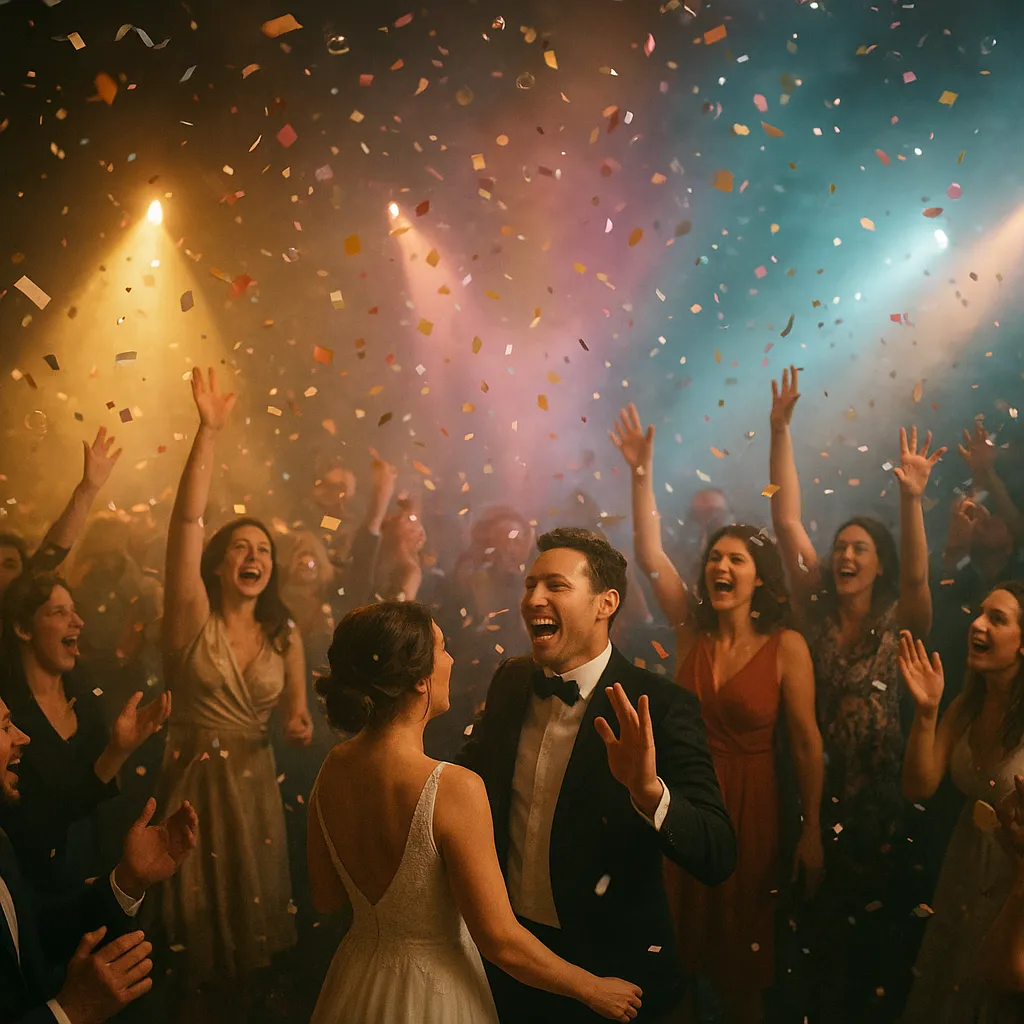
- Sparkler rules can differ sharply between venues just half an hour apart.
- The building’s alarm system decides whether haze is possible; it depends on the detector type.
- Check before you sign, get the answer in writing, and count on the fire inspector having the final say on the day.
In Austin, Tuscan Hall allows sparklers in specific areas when purchased through the venue. Mae’s Ridge in Dripping Springs bans traditional sparklers but allows cold sparklers from a few approved companies. Also in Dripping Springs, The Creek Haus states that no sparklers of any kind are allowed on site under any circumstances.
All three policies make sense. Still, you could not guess one from another, and that is the real point: no regional default exists, so you have to read that venue’s policy before you sign.
Cleanup that cannot be done, rather than a safety hazard, explains most wedding venue bans. Knowing which reason applies helps you judge whether a request has a chance.
What do venues usually ban?
The same bans appear again and again in published venue policies: confetti, glitter, rice, birdseed, fake flower petals, loose feathers, balloons, smoke bombs, fireworks and sparklers. Bubbles are usually allowed. More venues allow cold sparklers where they ban regular sparklers; cold sparklers look like sparks but have no live flame.
Three sources of a no
Once you group the rules by who sets them, the pattern becomes predictable.
1. Cost of cleanup
Tuscan Hall groups artificial petals, feathers, balloons, glitter, smoke bombs, rice, confetti and birdseed as items that are virtually impossible to clean up. It makes no mention of fire. Glitter would have to come off a lawn before the next day’s wedding, and there is no way to do that.
Venues will occasionally negotiate these rules, usually for a fee, so asking is reasonable.
2. The fire code and the inspector
Austin Fire issues permits for open flames as well as fireworks and pyrotechnics, among other categories, and points out that each event stays subject to site plan approval and fire inspection. The department also notes that how inspectors read the International Fire Code may require added public safety measures.
The venue didn’t create these rules, so you cannot negotiate them with the venue.
3. The alarm setup
Fog
Dense and easy to see, this effect usually remains close to the floor. People choose it for a first dance for that reason. Even so, it can be dense enough to look like a cloud of particles to any device monitoring the air.
Haze
Haze remains evenly spread and thin. The haze itself is not what you should see; its effect on light beams is. Because it puts much less material into the air for the same visual effect, it’s the usual choice for indoor rooms.
What makes this difference matter is the way sensors work. The National Fire Protection Association puts it in plain terms: photoelectric smoke alarms use a light source and a photosensitive cell, and when smoke enters the chamber, light scatters and is picked up by the photosensitive cell. A photoelectric alarm is generally more responsive to smoldering fires, the NFPA notes, while an ionization alarm is generally more responsive to flaming fires.
Here’s how a fog machine fits in. A photoelectric detector looks for light bouncing off particles in the air, while theatrical fog deliberately puts a cloud of particles there. That’s the whole mechanism, so the building, rather than the machine, determines the answer to “can we have haze”.
There is a standard for this
ANSI E1.23 covers the design, execution and maintenance of atmospheric effects in theaters, arenas and other places of public assembly. The Entertainment Services and Technology Association publishes the standard as an ANSI-accredited standards developer; the standard defines a “qualified person” responsible for mitigating hazards.
Haze at an event is not a gray area somebody improvises around. Asking a venue who their qualified person is and what type of detector monitors the room is a much better question than asking whether haze is allowed.
What Austin allows and does not allow
Austin Fire publishes its special event permits: open flame, fireworks and pyrotechnics, tents, outdoor events, public assembly, temporary change of use. Generators must sit twenty feet from any tent, and fuel fifty feet.
No fog or haze permit appears on the published list. That absence does not mean fog or haze is allowed, and the difference matters. In practice, this suggests that whether you can use atmospheric effects in Austin gets worked out between you, the venue and its alarm system, rather than at a permit office. Confirm it with your venue instead of relying on this page.
Comparing three published policies
| Venue | Sparklers | Confetti and similar |
|---|---|---|
| Tuscan Hall, Austin | Permitted in certain areas if bought through the venue. Bubbles are permitted too | Banned, including glitter, rice, birdseed, balloons and smoke bombs, as impossible to clean up |
| Mae’s Ridge in Dripping Springs | Traditional sparklers and fireworks banned. Cold sparklers allowed from approved companies | Confetti and rice prohibited. Candles permitted inside glass votives |
| The Creek Haus in Dripping Springs | Sparklers are never allowed, regardless of type or circumstances. Fireworks and Chinese lanterns are also prohibited. | The published FAQ does not specify this |
Policies change. We read these on July 27, 2026. Each venue’s own page is the authority, not this table.
What to ask and when
- Ask before you sign, rather than close to the party. Finding out in month eleven that your planned sparkler exit is not permitted poses a real problem.
- Get it in writing. A verbal yes from someone who does not work at the venue that day is not a yes.
- Find out who can authorize it that night. If nobody at the venue holds that authority, it’s effectively a no.
- For haze, raise the question of detectors. Ask which kind covers the room and if the system can be switched into any sort of supervised mode. The venue’s fire safety contractor is the one who answers this, not the events coordinator.
We provide stage lighting, but no haze, fog or pyrotechnics, so we’re reporting on this rather than offering it as a service. For the rest of the venue discussion, see house sound system or band-provided PA and the hour-by-hour timeline.
You’ll most often find effects coming up at galas and awards nights, where every minute of the program is scheduled. The corporate and gala page has more on that work.
Common questions
Can a fog machine set off the fire alarm?
It can, and the detector type is what decides it. NFPA describes photoelectric alarms as working by detecting light scattered off particles that enter the chamber, and theatrical fog is a cloud of particles. The venue’s alarm system, rather than the machine, is the thing to ask about.
What makes venues ban confetti?
Cleanup is usually the concern rather than safety. One Austin venue lists confetti alongside glitter, rice, birdseed and balloons, explaining that they are virtually impossible to clean up.
Do Austin wedding venues allow sparklers?
It depends entirely on the venue. Published policies from three venues within roughly an hour of each other set different rules: one allows sparklers bought through the venue, another allows only cold sparklers from approved vendors, and the third bans all sparklers under any circumstances.
Sources
- NFPA, “What kind of smoke alarm or smoke detector should I buy?” “Photoelectric smoke alarms utilize a light source and a photosensitive cell. When smoke enters the chamber, light scatters and is picked up by the photosensitive cell, causing the alarm to sound.” Also explains ionization and combination units. Read July 27, 2026. nfpa.org
- ANSI, “ANSI E1.23: Entertainment Technology Fog Effects”. ANSI E1.23-2020 covers the design, execution and maintenance of atmospheric effects in theaters, arenas and other places of public assembly. ESTA publishes it, and it defines a qualified person responsible for mitigating hazards. Read July 27, 2026. blog.ansi.org
- Austin Fire Department, “Special Events”. Its published permit list includes open flames and fireworks or pyrotechnics. “All events are subject to site plan approval and fire inspection.” Generators must be twenty feet from any tent, with fuel fifty feet away. Read July 27, 2026. austintexas.gov
- Tuscan Hall, Austin, “FAQ”. Bubbles and sparklers allowed in specific areas when purchased through the venue. Artificial petals, feathers, balloons, glitter, smoke bombs, rice, confetti and birdseed not allowed, as “virtually impossible to clean up”. Read July 27, 2026. tuscanhall.com
- Mae’s Ridge, Dripping Springs, FAQ. “we do not allow traditional sparklers, fireworks, confetti, or rice. However, we do allow cold sparklers from a few select, approved companies.” Accessed July 27, 2026. maesridge.com
- The Creek Haus, Dripping Springs, “FAQ”. “No fireworks, Chinese lanterns or sparklers of any kind are allowed on site under any circumstances.” Read July 27, 2026. thecreekhaus.com