Blog
How much space and power does a live band need?
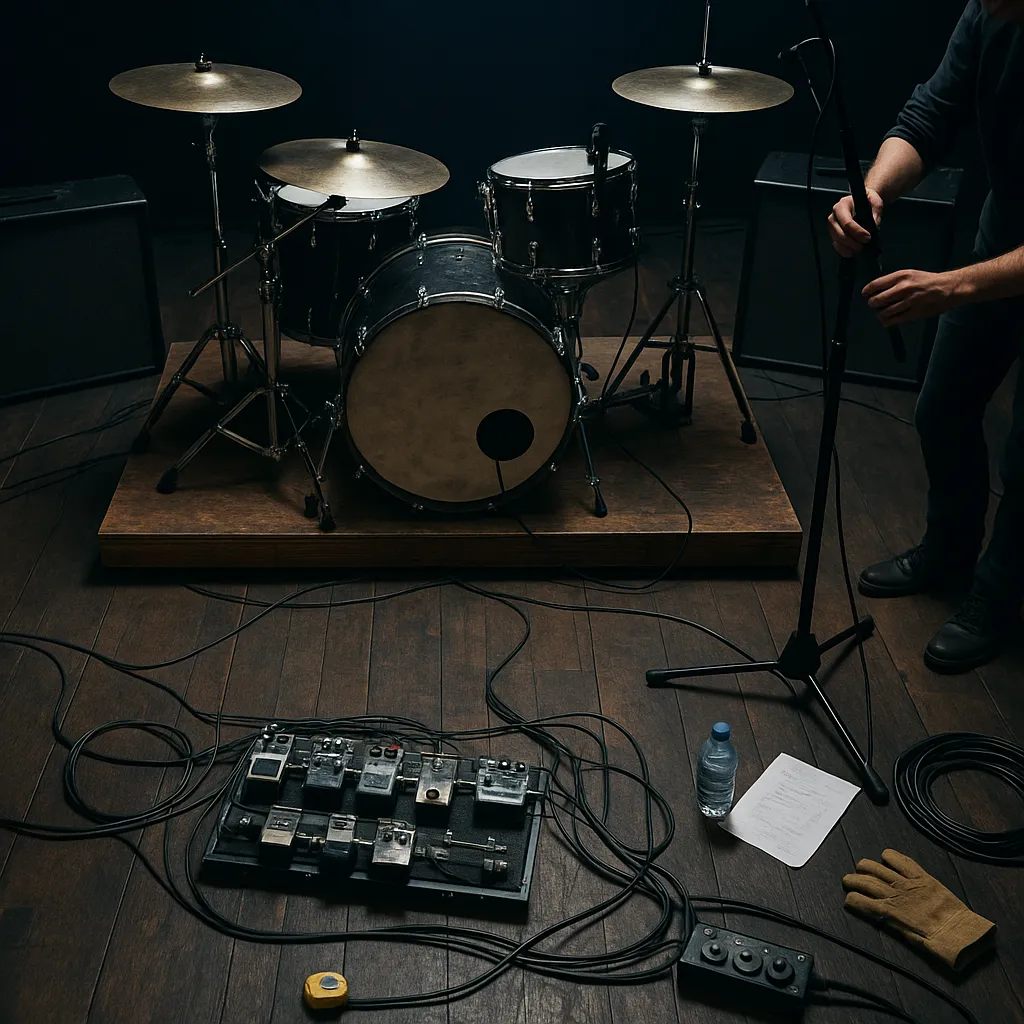
- The published stage charts begin at five pieces, which means a three-piece band takes up much less floor area than those charts imply.
- Check the number of distinct circuits supplying the stage, not the number of wall outlets.
- A band performing for an evening counts as a continuous load under the electrical code, so a 20-amp circuit provides about 1,920 usable watts rather than 2,400.
- The height of the ceiling and the route from the van are as important as the amount of floor space.
Among the thirty-six questions on The Knot’s wedding band checklist is a separately numbered item asking how much space do you need for yourself and your gear. The Knot then advises readers to check with the band so they can plan accordingly. On the category’s most-visited page, that is the whole answer.
Stage-size charts are another common resource. Those charts start with five to eight pieces needing 320 square feet, but they skip three- or four-piece bands, which make up most of the bands playing private events. That omission is why the question keeps coming up without an answer. Here is what we can tell you and what you should ask instead.
The space a live band needs onstage and the power it uses are two separate questions. For power, count the circuits that reach the stage rather than the outlets on the wall.
How much floor space does a live band need?
Published guidance points to more space than you need, but the real answer depends on the band. A compact three or four piece that brings its own PA takes up a fraction of the floor space a ten-piece with horns and a full backline requires, and the industry's own sizing tables have no row for the smaller end.
For a sense of the light end, here is our own rig, described rather than measured. Three musicians. The drum kit has a kick and snare, one rack tom, a ride, a hi-hat and a crash. A single twelve-inch guitar rig and a small bass rig, so there is no wall of cabinets behind anybody. We choose a PA that uses little floor space and put lights on trees instead of floor cans along the front of the stage, because those standing lights typically use up the depth of a small platform.
We intentionally left out a square footage figure. No one has measured our setup with a tape, and a number recalled from memory could be quoted back to us by a venue. The description does, however, point you to the small end of each table below as the place to start reading.
One number, then, is not the answer. The answer comes from asking how many players are in the band, whether they bring their own PA and lights, and where that equipment has to sit relative to the dance floor. Those answers produce your number. When a band cannot answer the first two without checking, that is worth noticing.
The published table and its limits
Rental companies publish space guides based on group size. Here’s a typical example. It helps, but only to a point.
| Stage | Square feet | Published for |
|---|---|---|
| 8 x 12 | 96 | Single speaker with a podium |
| 16 x 12 | 192 | A panel of speakers |
| 16 x 20 | 320 | 5 to 8 piece band |
| 16 x 24 | 384 | 8 to 10 piece band |
| 20 x 20 | 400 | 8 to 10 piece band, square |
| 16 x 28 | 448 | 10 to 12 piece band |
Look at what the chart leaves out. It jumps from a podium to a five-piece act, with 320 square feet required even for its smallest band entry. If you use that chart for a trio or quartet, you’re budgeting for roughly twice the stage space you need.
- 320
- Square footage for the smallest band row published
- 1,920
- Watts available for continuous use on a 20-amp circuit
- 3
- Hours of draw that make a load continuous under the code
- 125%
- Percentage of the continuous load a breaker must be rated for
Power, properly
Three terms are worth defining because they come up throughout. A branch circuit is one run of wire from the panel to a set of outlets, protected by a single breaker. Amperage is how much current that circuit can carry. A continuous load is the rule almost nobody applies to live music.
Explaining the National Electrical Code, Schneider Electric notes that section 210.20(A) requires a branch circuit breaker to handle the noncontinuous load plus 125% of the continuous load, and defines the term precisely: “A continuous load is one where the maximum current is expected to continue for 3 hours or more.”
A band playing through the evening fits that definition. From doors at seven until the event finishes at eleven, the PA remains on. The standard derating therefore applies and changes the calculation.
What people assume
20 amps at 120 volts equals 2,400 watts. With two of those circuits, the band has 4,800 watts available, which seems like more than enough for anyone.
What the code implies in practice
With a continuous load, the working figure falls to 80 percent: roughly 16 amps and 1,920 watts for each circuit. That is usually enough, though it is a fifth below what most people use when planning.
We did the math ourselves. The definition and the code reference are from Schneider’s summary of NFPA 70, and the venue’s own electrician has the final word on what the panel can really handle. We play music; we don’t wire buildings.
What you should ask instead
Don’t ask “are there outlets”. Even six outlets might use the same circuit, so their number tells you nothing. Ask instead:
- How many separate circuits does the stage area have?
- What’s their amperage?
- What other equipment uses those circuits? The usual two concerns are catering warmers and uplighting, and each affects the answer.
A band on its own circuit almost never trips a breaker. The common case is a band sharing a circuit with a chafing dish and eight uplights. That changes everything.
The stuff that isn’t floor area
- Ceiling height. Lighting stands go up, so a low ceiling pulls the lights down instead of stopping the band from fitting. Ask about it on its own, apart from floor space, because no floor plan ever tells you the ceiling height.
- The path in from the van. Setup time depends much more on distance, doorways, steps and the ground surface than on the gear.
- Where the PA sits relative to the dance floor. Speakers must stay ahead of microphones, and that restricts the room's shape, not only its dimensions.
- The room when it’s full. Check where the band will go with the floor plan arranged for the maximum guest count; that spot is often not the one shown on the plan.
Once you have the numbers, the rest of the venue conversation is in house sound system or band-provided PA, and the timing side is in how long a band needs to load in.
You can see what we offer for each event type on our band events page before hiring anyone. Backyards and tight rooms make this room-sizing question hardest, and we cover both under private parties.
Common questions
How much space does a three-piece band require?
Much less than the published tables say. Stage sizing guides begin at five to eight pieces and 320 square feet and never go below that, so a trio following them budgets for about twice the platform it really needs. Ask the band yourself, and check whether their figure covers the PA and lighting stands.
How many outlets will a band need?
That question misses the point. Ask how many separate circuits feed the stage and what else runs on them. Catering warmers and uplighting sharing the band’s circuit are a far more common source of trouble than the band’s own power draw.
Will a band trip a breaker?
Rarely on its own. Since the electrical code treats a band playing all night as a continuous load, a standard 20 amp circuit delivers roughly 1,920 usable watts rather than 2,400. Trouble almost always comes from sharing that circuit with something else.
Sources
- Schneider Electric, “Clearing up confusion over 80% vs. 100%-rated circuit breakers”. Explaining NFPA 70 section 210.20(A), and defining a continuous load as “one where the maximum current is expected to continue for 3 hours or more”. Read 27 July 2026. blog.se.com
- Reventals, “Stage Dimensions Guide for Events”. Stage sizes published by group size, running from one speaker at a podium on 8 x 12 up to a 10 to 12 piece band on 16 x 28. The smallest band listed is a 5 to 8 piece at 320 square feet. Read July 27, 2026. reventals.com
- The Knot, “36 Questions to Ask a Wedding Band That You Don’t Want to Forget”. “How much space do you need for yourself and your gear?” is question 3, and the published guidance is to ask the band. Read July 27, 2026. theknot.com
- Tuscan Hall, Austin, “FAQ”. Venue policy in print stating that professional bands and DJs supply their own sound systems, the other half of what the space has to hold. Read 27 July 2026. tuscanhall.com
- The Creek Haus, Dripping Springs, “FAQ”. The published limits include 150 people at most, around 60 primary parking spots, and space for about 10 cars in a vendor lot. These limits help determine where a band can set up. Accessed July 27, 2026. thecreekhaus.com