Blog
How long does a band need to load in?
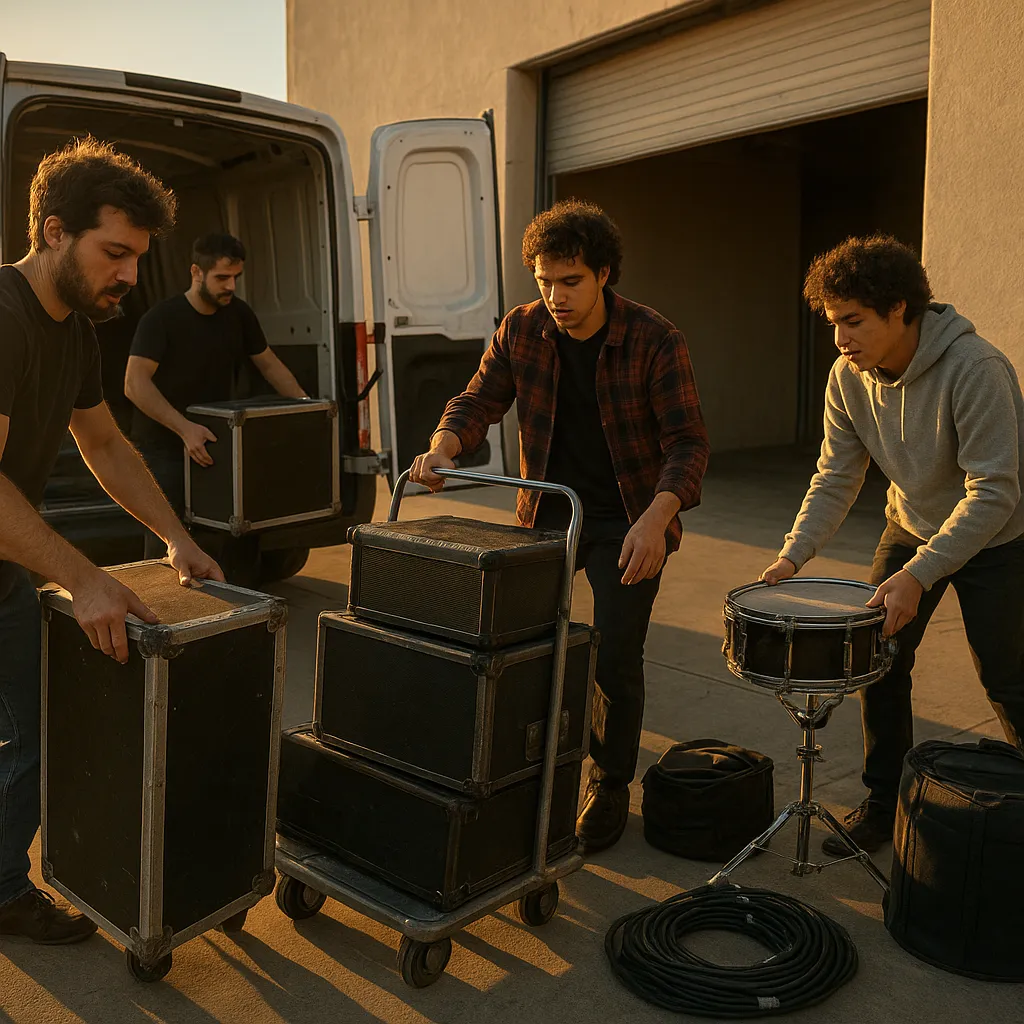
- The clock is set by the walk from the van to the stage, not by the gear count.
- Load-in and soundcheck have their own time slots. Only one can happen while guests are in the room.
- The standard wedding timeline already budgets a full hour of vendor load-out after the send-off.
- Some venues charge for that hour, so you should know which type you reserved.
Most couples don't see this figure. Mae’s Ridge in Dripping Springs publishes that its standard pricing includes one hour for post-event breakdown, with additional setup or late-night cleanup time available at $300 per hour.
So load-out isn't some vague event that takes place once you're gone. That time slot has a cost, and someone pays if the band is still wrapping cables at half past midnight. The published wedding timeline agrees it is real: it schedules 11:15 p.m. to 12:15 a.m. for clean-up and vendor load-out, a full hour after an eleven o’clock send-off. No one describes what goes on during it.
The time a band needs for load-in depends on how far the stage is from parking and what blocks the way, not how much gear the band owns.
How much time does load-in take?
There is no single honest answer, and a group that provides one without knowing your venue specifics is guessing. What can be shared is what professional bookers include in their written requests, and they mostly align.
| Window | Published figure | Source |
|---|---|---|
| Load-in, setup, and soundcheck | Between 60 and 90 minutes | Alive Network |
| Setup alone | Requested time: 90 minutes | Tailored Entertainment |
| Soundcheck alone | 15 to 20 minutes; a larger band needs longer | Tailored Entertainment |
| Combined load-in, setup and soundcheck | Between 90 minutes and 3 hours | Greenlight Bands |
| Teardown and load out | Between 45 and 60 minutes | Alive Network |
| Time between the soundcheck and guests arriving | 30 minutes at a minimum | Greenlight Bands |
Consider the entire spread rather than the midpoint. That range from 60 minutes to 3 hours for the same task isn't a disagreement about work speed. It depends on how far the van is from the stage, whether there are stairs, and if the room is still being set while you move gear through it.
A band's place in that range depends mostly on how much gear it has to carry. Ours is deliberately at the light end: three players, a compact kit of kick, snare, one rack tom, ride, hi-hat and crash, a single twelve-inch guitar rig, a small bass rig, and a PA and lighting package chosen for a small floor footprint with the lights flown on trees rather than standing in cans across the front. With fewer cases, there are fewer trips and less space to clear before setup can begin.
Two of those figures are worth factoring into your own schedule. When the band needs 90 minutes and you want a 30 minute cushion before doors open, you'll need to arrange access with the venue for two hours before guests show up, not one. Once the last song ends, pack-down takes 45 to 60 minutes, and that's the window venues use when billing overtime.
The figure worth having is one you can take yourself in about four minutes, under “The thing you can actually do about it”.
Where the time goes
First, four terms that people use as if they mean the same thing, though they don't. Load-in means moving gear from the vehicle onto the stage. Setup means putting it together and connecting the cables. Soundcheck means adjusting the sound for that particular room. Load-out, also called the strike, reverses the process; it always takes less time than people expect but more than the schedule provides.
What changes the number:
- The distance from where the van can stop to the stage. The single biggest factor. Carrying gear forty feet across a flat entrance is a different job than hauling it two hundred feet over grass.
- Steps and thresholds. One step adds more work than thirty feet of level floor because everything must be lifted rather than rolled.
- Surface. Wheels get stuck on gravel, grass and cobblestones. A job that takes two trips then takes six.
- Elevators. One works fine if the inside of the cab takes the band's largest case. Ask for the interior dimensions rather than taking a verbal yes.
- A room still being set up. Nobody can bring gear in if the caterer is placing tables in the stage area.
- One door for everyone. When three vendors all wait at a single service entrance, a line forms, and lines are not in anybody’s estimate.
An easy load-in
Van parks forty feet from ground-floor door. Flat, no step, wide enough for a rolling case. The floor plan is already set and the room is empty. Power is exactly where somebody said it would be.
A hard load-in, same gear
The parking spot is two hundred feet from the building, with gravel to cross. A gate keeps swinging shut, two steps take you into the room, and the catering team is still turning it over. Loading in takes three times longer, though the band causes none of the delay.
- 60 to 90
- Minutes a wedding band needs to load in, set up and soundcheck, per Alive Network
- 45 to 60
- Time in minutes to strike and load out after the last song, same source
- 1
- Hour of vendor load-out in the standard published timeline
- $300
- Cost per hour beyond that at one published Hill Country venue
- 15
- How many minutes remain on your booking when an Austin venue stops indoor music
- 10
- Parking spaces for vendors at one published Hill Country venue
The thing you can actually do about it
First, walk the route empty and time it. Begin where a vehicle can legitimately park, pass through each door, and finish at the band's setup spot.
The wedding industry doesn't tell you to do this, though it takes only four minutes. A working band does exactly this on a site visit because walking the route answers more questions than talking about it. If you can cover that path empty-handed in ninety seconds, a crew carrying cases will take considerably longer on each trip and make it several times.
Soundcheck is where things go wrong
Showing up late does not cut the band's setup time. Instead, the band soundchecks as guests arrive, exactly what everyone hoped to avoid. A soundcheck is inherently loud and repetitive, with nothing glamorous about it, and it cannot happen quietly.
So the constraint that matters is not when the band may arrive, it is when the room is genuinely empty and available. Those are often different times, and the contract only shows one.
Ask for this schedule
- When is the room empty and available?
- What time do the first guests arrive?
- When must the soundcheck be complete? Work backward from question two.
- What time does the music need to end? This is decided by the venue, and it's explained in the hour-by-hour timeline.
- What time must everyone be off the property, and does the rental cover that hour or cost extra?
Five questions, with answers to the first and last being the two most people never think to ask. The rest of the production conversation is in how much space and power a band needs and house sound or a band PA.
We bring the same rig to every event. Our band page explains what changes by event type. Load-in windows are almost always shortest in hotel ballrooms working around plated dinners; our page on corporate events and galas covers those events.
Common questions
How long before the event should a band arrive?
The band should arrive early enough to finish soundcheck before the first guest gets there; that is the limit that matters.
How long does a band need to pack up?
Once the send-off ends, the standard published wedding timeline gives vendors a full hour to load out. At least one Austin-area venue includes one hour in its price and charges $300 per hour after that.
Can a band set up with guests in the room?
Yes, but it means soundchecking in front of an audience. Ask the venue when the space is genuinely empty, rather than when the band is permitted to arrive.
Sources
- Alive Network, “How long does a band need to set up?”. That almost every wedding band needs 60 to 90 minutes to load in, set up and sound-check before performing, and that bands typically need 45 to 60 minutes to pack down and load out after the final song. A wedding band agency stating its own operating requirement. Read July 29, 2026. alivenetwork.com
- Tailored Entertainment, “How long does a band sound check take?”. The agency requests 90 minutes of setup time for its bands. It says a live band needs 15 to 20 minutes or longer to soundcheck, depending on band size. Read July 29, 2026. tailored-entertainment.com
- Greenlight Bands, “How to coordinate wedding band logistics”. According to Greenlight Bands, most professional wedding bands need from 90 minutes up to 3 hours to bring in gear, set up and soundcheck before guests arrive. Greenlight Bands also recommends leaving a minimum 30 minute buffer after soundcheck ends and before the first guests arrive. Read July 29, 2026. greenlightbands.com
- The Knot, “The Wedding Reception Timeline You Need to Plan Ahead”. Schedules 11:15 p.m. to 12:15 a.m. for clean-up and vendor load-out after an 11:00 p.m. send-off. Read July 27, 2026. theknot.com
- Mae’s Ridge, Dripping Springs, FAQ. “We include 1 hour of post-event breakdown time in our standard pricing”, and “Additional setup or late-night cleanup hours are available for $300/hour.” Read July 27, 2026. maesridge.com
- The Knot, “36 Questions to Ask a Wedding Band That You Don’t Want to Forget”. Covers the band's arrival time, whether the rate includes setup and breakdown, and whether the band plays more than one event per day. Accessed July 27, 2026. theknot.com
- The Creek Haus, Dripping Springs, “FAQ”. Roughly 60 main spaces for cars plus a vendor area that fits about 10 more, given as a published case of where a vehicle can actually stop. Read July 27, 2026. thecreekhaus.com
- Tuscan Hall, Austin, “FAQ”. Indoor music “will be discontinued 15 minutes before the end of your reservation time”, which is the boundary the load-out clock starts from. Read July 27, 2026. tuscanhall.com